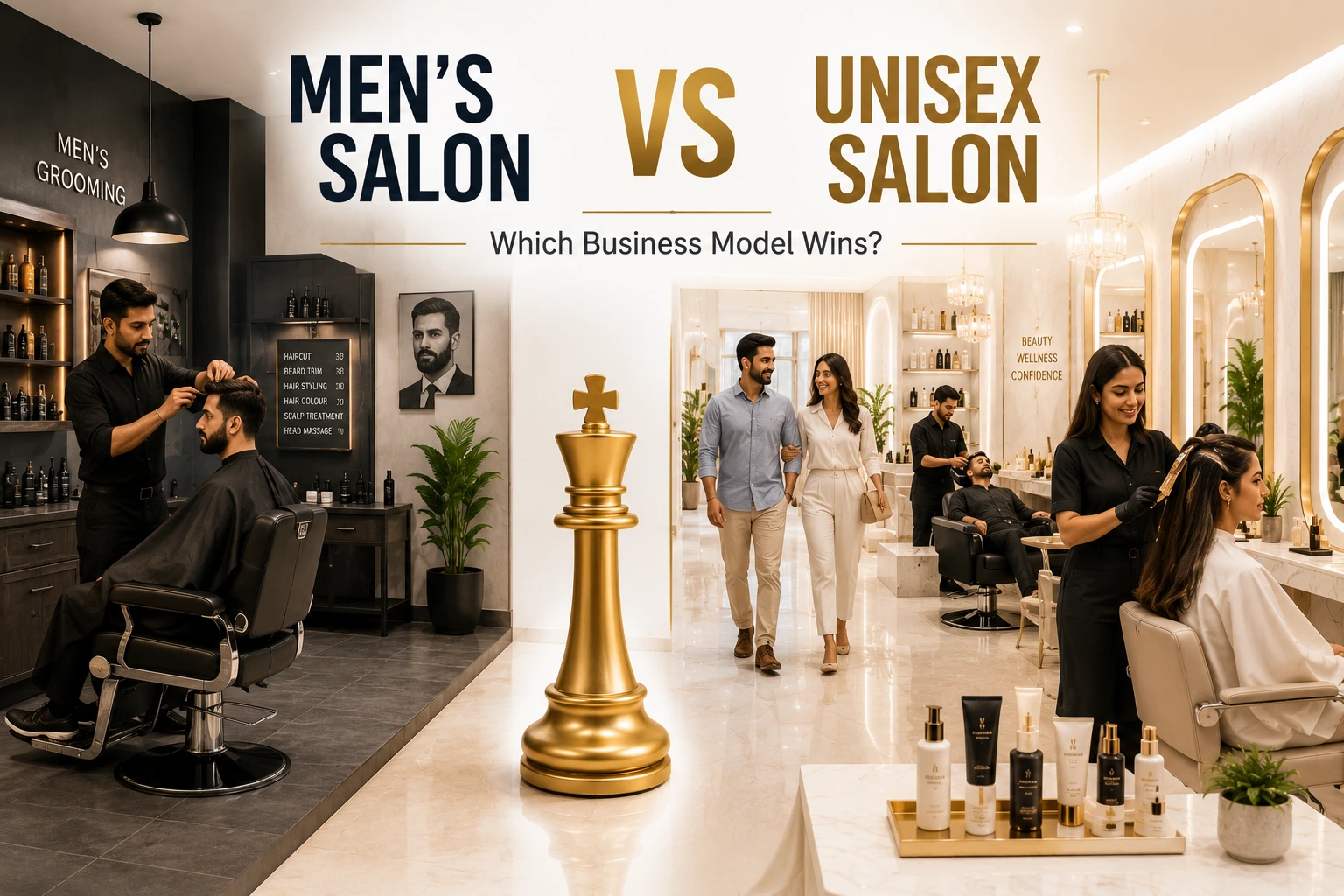
The Indian beauty and wellness industry is undergoing an explosive, multi-billion-dollar transformation. Just a decade ago, the market was strictly divided between basic barbershops and traditional women’s beauty parlors. Today, consumer psychology has completely evolved. High-net-worth individuals, modern corporate professionals, and elite couples now demand sophisticated, luxurious grooming experiences. As an ambitious entrepreneur preparing to invest significant capital, you face a massive strategic decision at the very beginning of your journey: Men’s Salon vs Unisex Salon: Which Business Model Is Better?
This is not just a branding question; it is a mathematical equation. Your choice determines your commercial real estate requirements, your staff payroll structure, and your ultimate gross profit margins. A specialized men’s salon targets a specific, fast-moving demographic, while a premium unisex destination captures the entire market and offers massive cross-selling opportunities.
Whether you are a solo investor trying to bootstrap an independent boutique or evaluating the immense financial safety provided by a premium corporate franchise, this comprehensive pillar guide is your ultimate operational roadmap. We will strip away the guesswork and break down the exact unit economics of both setups. Here is the definitive financial analysis of the Men’s Salon vs Unisex Salon: Which Business Model Is Better debate to secure your financial legacy.
1. Analyzing the Dedicated Men’s Salon Model
To properly evaluate the Men’s Salon vs Unisex Salon: Which Business Model Is Better dilemma, we must first analyze the specialized men’s grooming sector. The modern Indian man is highly conscious of his appearance and is willing to spend money on premium beard spas and advanced scalp treatments.
- The Advantage: The initial capital required to open a dedicated men’s salon is generally lower. You do not need massive square footage to accommodate large bridal suites or heavy skin rejuvenation machinery. The business relies on speed and high daily footfall.
- The Disadvantage: While the volume is high, the “Average Ticket Size” (how much one client spends per visit) is heavily capped. A premium men’s haircut might generate ₹1,000 to ₹1,500. Furthermore, by restricting your brand to men only, you are completely blocking 50% of the population from entering your business.
When you look at the sheer financial scale of Men’s Salon vs Unisex Salon: Which Business Model Is Better, restricting your potential customer base is often a dangerous move for long-term corporate wealth generation.
2. Analyzing the Comprehensive Unisex Salon Model
Now let us explore the other side of the Men’s Salon vs Unisex Salon: Which Business Model Is Better debate. A premium unisex salon caters to both men and women simultaneously, offering precision haircuts, advanced skin care, and exclusive bridal artistry under one luxurious roof.
- The Advantage: By opening your doors to everyone, you instantly double your potential customer base. More importantly, unisex salons focus heavily on high-ticket luxury services for women (like Balayage, Keratin treatments, and bridal makeup), where gross profit margins naturally sit between 40% to 60%.
- The Cross-Selling Magic: A husband and wife can visit the salon together. While she gets a global hair color, he can receive a luxury pedicure and scalp massage. This shared experience drastically increases the daily revenue generated by a single booking block.
- The Disadvantage: The initial setup cost is significantly higher. You must invest in a larger premium commercial space, flawless 4000K daylight lighting, and soundproof wellness spa zones to justify your high-ticket pricing.
However, when reviewing the financial spreadsheets to answer Men’s Salon vs Unisex Salon: Which Business Model Is Better, the massive daily revenue of a comprehensive unisex salon easily covers the higher initial setup costs.
3. The Power of Retail Product Sales
Another massive factor in deciding Men’s Salon vs Unisex Salon: Which Business Model Is Better is retail product sales. True wealth in the grooming industry is generated by selling premium home-care products directly to your clients.
- The Men’s Salon Limitation: While men buy hair wax and beard oils, their retail spending is generally limited. The product range required is small, which caps your secondary revenue stream.
- The Unisex Dominance: A premium unisex salon features a massive retail display for both genders. You can sell global luxury haircare products, high-end dermatologist-approved skincare kits, and premium cosmetic tools.
Selling these retail products carries a lucrative 20% to 30% profit margin and requires absolutely zero extra service time. This optimized, multi-category secondary revenue stream heavily tips the scales when analyzing Men’s Salon vs Unisex Salon: Which Business Model Is Better.
4. Modern Consumer Psychology and Brand Loyalty
The psychology of the modern luxury consumer has shifted. When evaluating the Men’s Salon vs Unisex Salon: Which Business Model Is Better equation, you must understand what premium clients actually want.
In 2026, grooming is about ultimate convenience and time-saving luxury. High-net-worth couples and busy corporate professionals absolutely refuse to visit different shops for their respective grooming needs. They demand a single, premium luxury destination that handles everything. A comprehensive unisex salon offers exactly this.
By catering to this desire for absolute convenience and shared experiences, premium unisex salons naturally command fierce brand loyalty and massive client retention, effectively providing a clear answer to Men’s Salon vs Unisex Salon: Which Business Model Is Better.
The Ultimate Solution: The Premium Corporate Franchise
Reading through this guide, it is obvious that the comprehensive unisex salon model is vastly superior for aggressive wealth generation. However, building a massive premium unisex destination independently requires immense capital, usually between ₹30 Lakhs to ₹80 Lakhs. Managing commercial leases, architectural build-outs for different gendered zones, and recruiting elite staff for both male and female services is highly stressful.
This is exactly why the smartest investors bypass the independent startup phase entirely. If you want the ultimate, risk-free answer to Men’s Salon vs Unisex Salon: Which Business Model Is Better, you must invest in a premium corporate franchise.
When you partner with a trusted luxury brand like The Salon Company, you step directly into a highly profitable, perfectly optimized unisex business model.
Here is how our franchise ecosystem guarantees your massive success:
- Flawless Turnkey Setup: We handle expert site selection and oversee the entire luxury architectural execution, ensuring your premium unisex salon features distinct, soundproofed service zones that meet global aesthetic standards.
- The Elite Training Academy: We continuously upskill your master stylists to ensure they deliver absolute perfection across both male and female high-ticket services.
- Optimized Vendor Pricing: Because of our massive corporate bulk tie-ups, you buy premium hair and skin luxury products at heavily discounted vendor rates, instantly boosting your net profit on both sides of the business.
Because our corporate framework removes the financial and operational guesswork, our franchise partners never have to stress over the Men’s Salon vs Unisex Salon: Which Business Model Is Better dilemma. With an initial investment ranging from ₹30 Lakhs to ₹80 Lakhs, this highly optimized structure allows partners to target an aggressive 35% ROI (Return on Investment) and recover their capital within a fast 18 to 24 months payback period.
Quick Comparison: The Financial Reality
To make the financial logic absolutely undeniable, let us look at a quick comparison table. If you want a visual summary to finally conclude the Men’s Salon vs Unisex Salon: Which Business Model Is Better debate, look at the difference between the two business models.
| Business Metric | Dedicated Men’s Salon | Comprehensive Unisex Salon (Franchise) |
| Target Audience | Limited to 50% of the population (Men only). | 100% of the population (Men, Women, Couples). |
| Average Ticket Size | Lower. Capped by quick, basic styling services. | Massive. Heavy cross-selling of high-ticket luxury services. |
| Retail Sales Scope | Restricted mostly to basic styling products. | Huge. Sells premium skincare, cosmetics, and global haircare. |
| Client Convenience | Low. Couples must go to separate locations. | High. A “One-Stop” luxury grooming destination for everyone. |
| Profit Potential | Growth is limited by a restricted audience. | Highly scalable, targeting a massive 35% ROI. |
If you follow the right side of this table, you have successfully understood the final truth of the Men’s Salon vs Unisex Salon: Which Business Model Is Better comparison.
Conclusion
Understanding the deep operational mechanics of the Men’s Salon vs Unisex Salon: Which Business Model Is Better debate is the ultimate key to transitioning from a stressed local shop owner into a highly wealthy beauty empire investor. While a specialized men’s salon is slightly cheaper to open, its restricted service menu and capped demographic make it incredibly difficult to scale revenue aggressively.
In the premium grooming sector, a comprehensive luxury unisex salon is the ultimate wealth-generation vehicle. By doubling your potential customer base, offering high-ticket precision styling, and capturing massive retail sales from both genders, your gross profit margins absolutely soar all year round.
However, building a massive unisex salon from scratch is incredibly risky. If you want to own a high-growth luxury salon where the vendor costs, marketing systems, and architectural blueprints are already perfected for you, aligning with a corporate franchise is the smartest financial move you can make.
Are you ready to build a massively profitable luxury empire backed by a proven, stress-free corporate system? Partner with the Leaders of Luxury at The Salon Company and let our exclusive franchise ecosystem secure your financial legacy today!
Frequently Asked Questions (FAQs)
Q1: What is the main conclusion of the Men’s Salon vs Unisex Salon: Which Business Model Is Better debate?
The main conclusion is that a unisex salon is vastly superior for profitability. By catering to both men and women, you instantly double your customer base. Furthermore, the inclusion of high-ticket women’s services (like bridal makeup and keratin) massively increases your average ticket size.
Q2: Is a unisex salon more expensive to open?
Yes. To attract high-net-worth men and women, a comprehensive unisex salon requires a larger commercial space, premium luxury interiors, and advanced skin machinery. The initial investment typically ranges from ₹30 Lakhs to ₹80 Lakhs, but the ROI is significantly higher.
Q3: Which model has a higher ROI in the Men’s Salon vs Unisex Salon: Which Business Model Is Better comparison?
The comprehensive unisex salon model has a much higher ROI. Because they sell expensive skin treatments and luxury retail products across multiple categories, premium franchises like The Salon Company consistently target an aggressive 35% ROI.
Q4: Do couples actually prefer visiting unisex salons together?
Absolutely. In 2026, grooming is about ultimate convenience. High-net-worth couples and busy professionals prefer a “one-stop” premium destination where they can receive all their high-end grooming services simultaneously without traveling to different shops.
Q5: How fast can I recover my money if I invest in a premium unisex franchise?
By using our proven operational framework and achieving a targeted 35% ROI, our franchise partners usually recover their entire initial ₹30-80 Lakhs capital investment within a highly predictable and fast 18 to 24 months.
Latest Insights from The Salon Company
To stay updated with the latest trends in the salon industry, explore our previous business guides: